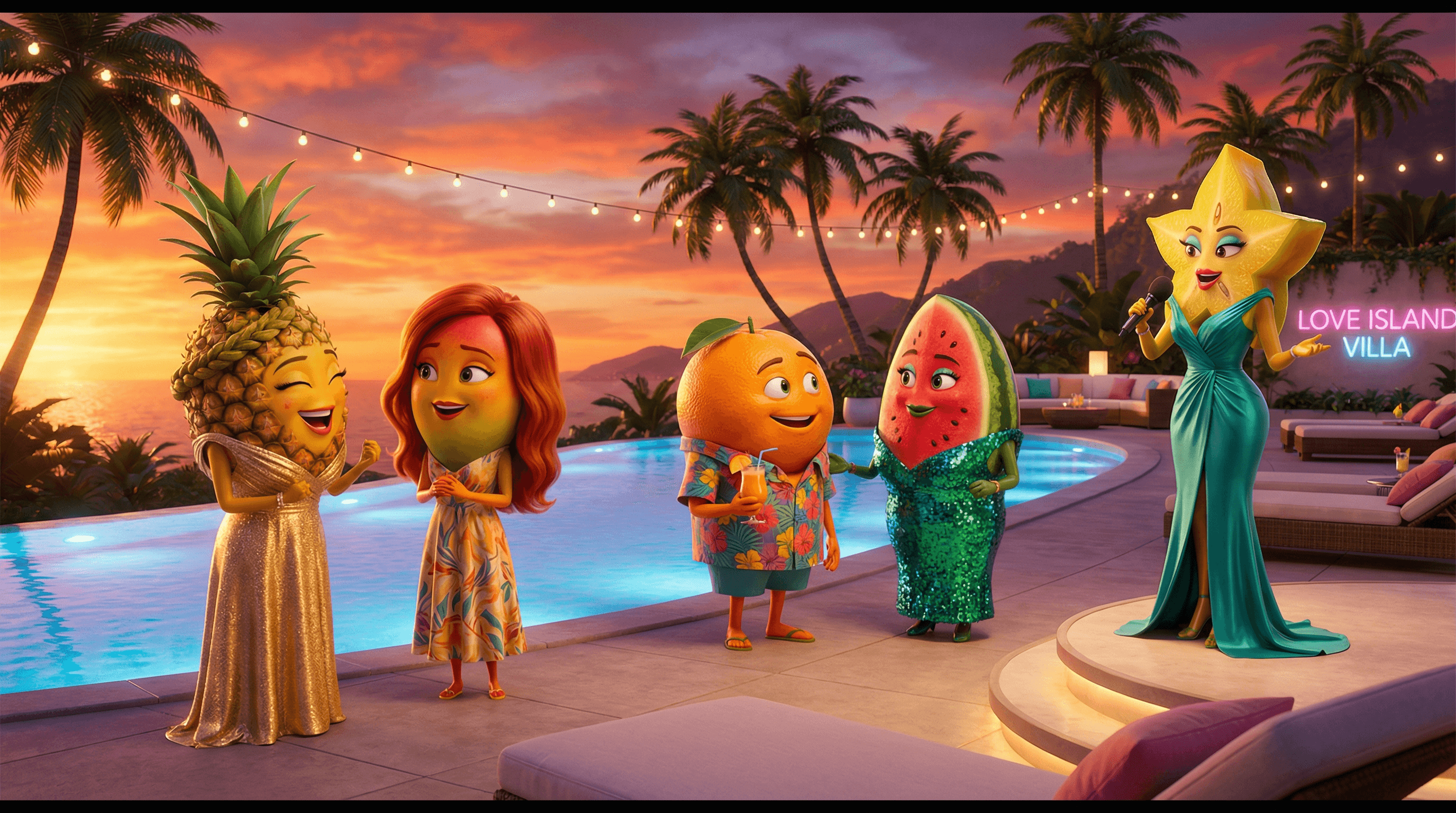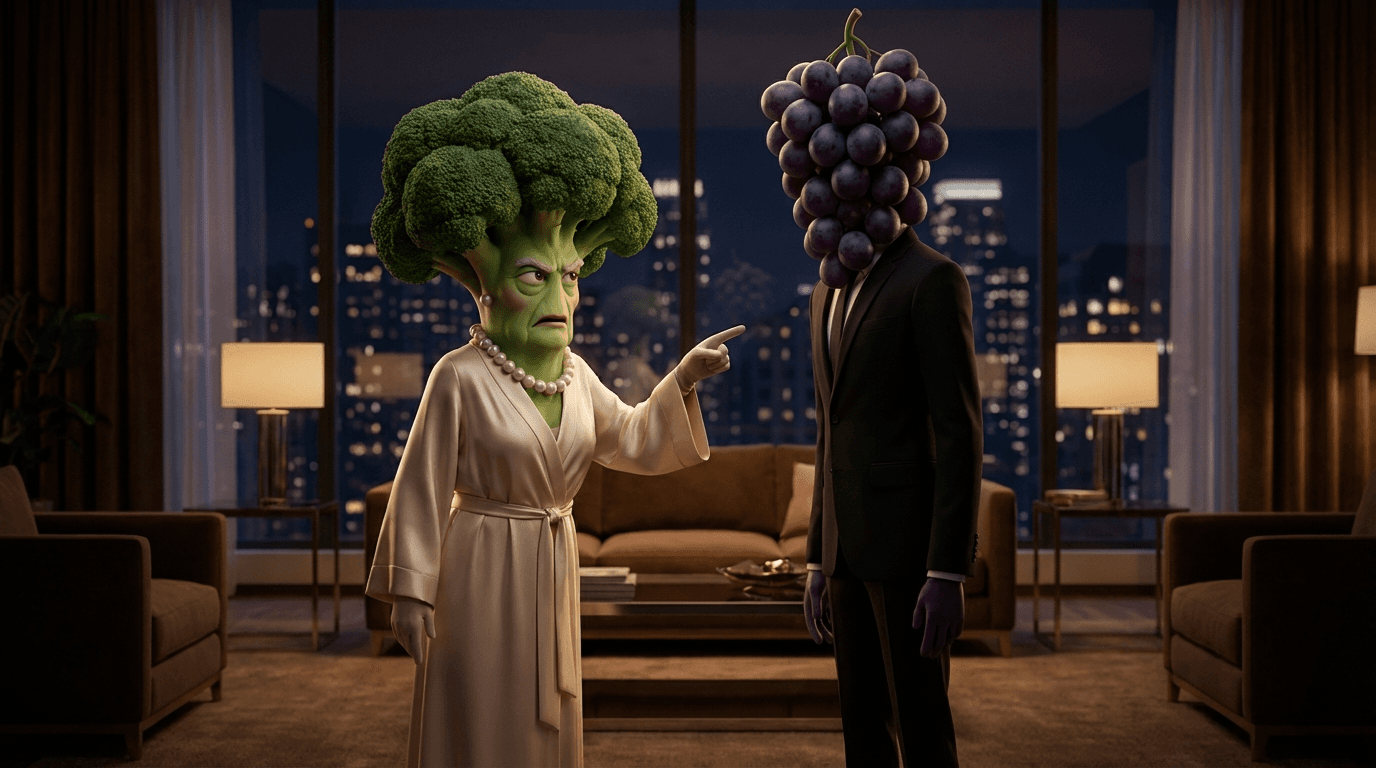

You've probably seen them by now: a pregnant broccoli lady weeping in a Manhattan penthouse (24.5 million views), a grape villain confronting his strawberry ex-wife at a charity gala (9 million views), or a broccoli grandmother discovering her husband's secret family (8.2 million views). AI fruit drama videos have exploded into one of TikTok's biggest formats, and they show no signs of slowing down.
If you've already read our Fruit Love Island tutorial, this is the next evolution. While Love Island is a dating show format with eliminations and coupling, fruit drama is pure soap opera, think telenovela-level storylines with vegetables and fruits as the cast. Affairs, betrayals, pregnancies, family feuds, plot twists. The emotional stakes are absurdly high for characters made of produce, and that's exactly why millions of people can't stop watching.
What Are AI Fruit Drama Videos?
AI fruit drama videos are serialized short-form content featuring anthropomorphic fruit and vegetable characters in dramatic storylines. Each character is a 3D-styled AI-generated figure, a broccoli with human proportions wearing designer clothes, a strawberry in a cocktail dress, a grape in a tailored suit, placed in cinematic scenes that look like stills from a Pixar-meets-telenovela production.
The format typically works as a series: creators build a cast of 5-10 recurring characters with distinct personalities and relationships, then release episodes of 1-2 minutes each. Each episode advances the storyline with 4-6 scenes, each scene being an AI-generated image animated into a short video clip with voiceover narration.
The top creators in this space are pulling insane numbers. Individual episodes regularly hit 2-10 million views, and the most viral moments (pregnancy reveals, confrontation scenes, character deaths) have broken 24 million+. Several of the biggest fruit drama accounts use Flashloop for their image generation, you can see the "Made with Flashloop.app" watermark on many viral clips.
Why Fruit Drama Videos Get Millions of Views
This format works because it taps into the exact same psychology as reality TV and soap operas, but with a surreal twist that makes it uniquely shareable:
- Emotional hooks are universal, betrayal, jealousy, love triangles, and family secrets work whether the characters are humans, puppets, or animated broccoli. The emotional core transcends the absurdity of the medium.
- Serialized content builds audiences, viewers come back for episode 2, 3, 10. Each new episode brings all existing followers back AND gets pushed to new viewers via the algorithm. Compare this to one-off content where every video starts from zero.
- The absurdity IS the hook, a pregnant broccoli lady crying is inherently funny and shareable in a way that realistic AI drama isn't. The vegetable characters lower the barrier to entry, people share it because it's ridiculous, then stay because they're genuinely invested in the storyline.
- Comments fuel the algorithm, viewers argue about characters, predict plot twists, and take sides in relationship drama. High comment engagement tells TikTok to push the video harder.
Fruit Drama vs Fruit Love Island: What's the Difference?
These are two distinct subgenres that often get confused. Here's the breakdown:
| Feature | Fruit Love Island | Fruit Drama |
|---|---|---|
| Format | Dating show / competition | Soap opera / telenovela |
| Structure | Coupling, recoupling, eliminations | Ongoing storylines with plot twists |
| Setting | Villa, pool, fire pit | Penthouses, hospitals, mansions, offices |
| Tone | Flirty, competitive, fun | Dramatic, emotional, intense |
| Character arcs | Shallow (who likes who) | Deep (family histories, secrets, betrayals) |
| Audience retention | High (competition format) | Very high (emotional investment) |
The fruit drama format tends to produce higher individual video views because each episode can stand alone as a dramatic moment, while Love Island episodes need more context. A clip of a broccoli finding out she's been cheated on works even if you've never seen the series before. For a deep dive on the dating show format, check out our complete Fruit Love Island tutorial.
Step 1: Create Your Cast of Characters
The foundation of a great fruit drama series is a compelling cast. Each character needs three things: a distinct visual identity, a clear personality archetype, and relationships to other characters.
Character Archetypes That Work
- The Matriarch (Broccoli), the family elder. Wise, powerful, emotional. The broccoli grandmother is by far the most viral character type. Something about the broccoli "hair" reads as an elegant older woman. Usually in robes, pearls, or formal gowns.
- The Villain (Grape/Eggplant), dark-colored fruits and vegetables naturally read as antagonists. Grapes in purple suits, eggplants in black. They scheme, manipulate, and betray.
- The Temptress (Strawberry/Cherry), red fruits in glamorous outfits. They're the ones causing relationship drama, usually involved in love triangles.
- The Innocent (Banana/Corn), lighter-colored, more innocent-looking characters. They get caught up in the drama, often as victims or peacemakers.
- The Heir (Avocado/Pepper), the next generation. Young, ambitious, torn between family loyalty and personal desires.
Designing Consistent Characters
Consistency is the hardest part of AI-generated character content. Your broccoli grandmother needs to look the same across every scene in every episode. Here's how:
- Create a detailed character reference prompt, write one master prompt per character that describes their exact appearance: body proportions, clothing style, accessories, expression range, and specific fruit/vegetable features.
- Generate reference images first, use Flashloop's image generator to create 5-10 images of each character in different poses. Pick the best ones as your canonical references.
- Use image-to-image for scenes, when generating actual episode scenes, include your reference images and describe the character by their specific visual details rather than generic terms.
- Keep a character bible, a simple document with each character's name, appearance notes, personality, and key relationships. You'll reference this constantly.
Pro tip: Include a "signature item" for each character, pearl necklace for the matriarch, red lipstick for the temptress, gold watch for the villain. These visual anchors help the AI (and viewers) keep characters consistent and recognizable.
Step 2: Write Your Episode Script
Each episode needs 4-6 scenes that advance the story. The most viral format follows a soap opera structure:
- Scene 1: Recap or context, a brief establishing moment that reminds viewers where the story left off. "It had been three months since the wedding..."
- Scene 2-3: Rising tension, something is discovered, overheard, or confronted. "She found the messages on his phone..."
- Scene 4-5: The dramatic peak, the confrontation, the reveal, the breakdown. This is the scene people clip and share. "You're not the father!" or "I've known about her for years."
- Scene 6: Cliffhanger, leave viewers desperate for the next episode. A phone ringing, a door opening, a positive pregnancy test. Never resolve everything.
Storylines That Get the Most Views
Based on what's performing right now on TikTok, these storyline themes consistently go viral:
- Infidelity/cheating reveals, the #1 performer. The moment one character discovers another's betrayal is always the most shared scene.
- Pregnancy reveals (especially unexpected), the pregnant broccoli format is a genre unto itself. Secret pregnancies, surprise twins, "who's the father?" plotlines.
- Family dynasty drama, wealthy vegetable families fighting over inheritance, business empires, and power.
- Revenge arcs, a wronged character spends multiple episodes building toward a satisfying payback moment.
- Secret identity/hidden past, characters who aren't who they claimed to be.
Step 3: Generate Your Scenes with AI
For each scene in your script, you need an AI-generated image that you then animate into a short video clip. Here's the workflow:
Image Generation
For each scene, write a detailed image prompt that includes:
- Which characters are present (described by visual appearance)
- The setting (penthouse living room, hospital corridor, garden)
- The emotional tone (tense, romantic, angry, sad)
- Camera angle and composition (medium shot for dialogue, close-up for emotional moments)
- Lighting mood (warm for intimate scenes, cold for dramatic ones)
Use Flashloop's image generator to produce each scene. Generate 3-5 variations per scene and pick the one with the best composition and emotional expression.
Image-to-Video Animation
Once you have your scene images, animate them using Flashloop's video generator in image-to-video mode. Each clip should be 3-5 seconds, just enough motion to bring the scene alive. Write a motion prompt describing what should move:
- "The character turns slowly to face camera, expression shifts from smile to shock"
- "Slow push-in on the character's face as tears form in their eyes"
- "Two characters arguing, gesturing dramatically, the one on the left points accusingly"
Important: In your video/motion prompts, describe characters by their appearance ("the green broccoli-headed woman in the white robe") rather than by name. The AI doesn't know character names, only visual descriptions.
Step 4: Add Voiceover and Music
Voiceover narration is what turns a slideshow into a drama. The best fruit drama videos use a narrator voice that sounds like a true crime documentary or telenovela narrator, serious, dramatic, slightly over the top.
- Text-to-speech tools, ElevenLabs and PlayHT both produce natural-sounding dramatic narration. Pick a voice that sounds like it's telling you a serious story, not a corporate presentation.
- Keep voiceover scripts short, 80-90 characters per scene, or about 5-8 seconds of audio per clip. The narration should complement the image, not describe everything you can already see.
- Background music, use dramatic orchestral music, telenovela-style piano, or tense thriller music. Keep it subtle, the voice and visuals carry the emotion, music just enhances it.
Step 5: Edit for TikTok and Post
Assembly is straightforward:
- Import all your animated scene clips into CapCut (or any editor)
- Add the voiceover audio track, syncing each line to its scene
- Add subtitles, this is non-negotiable for TikTok. Most viewers watch with sound off initially, and subtitles keep them engaged long enough to turn sound on.
- Add background music at low volume (15-20% of voiceover level)
- End on a cliffhanger frame with text: "Part 12 tomorrow..." or "Follow for the next episode"
- Export at 9:16 for TikTok/Reels/Shorts
Example Prompts for Fruit Drama Scenes
These prompts are for the image generation step. Use them as templates for your own scenes:
The Confrontation
Dramatic scene in a luxurious penthouse living room at night. An elderly broccoli woman in a silk ivory robe and pearl necklace stands pointing accusingly at a tall grape man in a tailored black suit. Both have intense angry expressions. Floor-to-ceiling windows showing city skyline. Warm lamp lighting with dramatic shadows. 3D animated style, photorealistic, cinematic composition, 9:16 vertical.
The Pregnancy Reveal
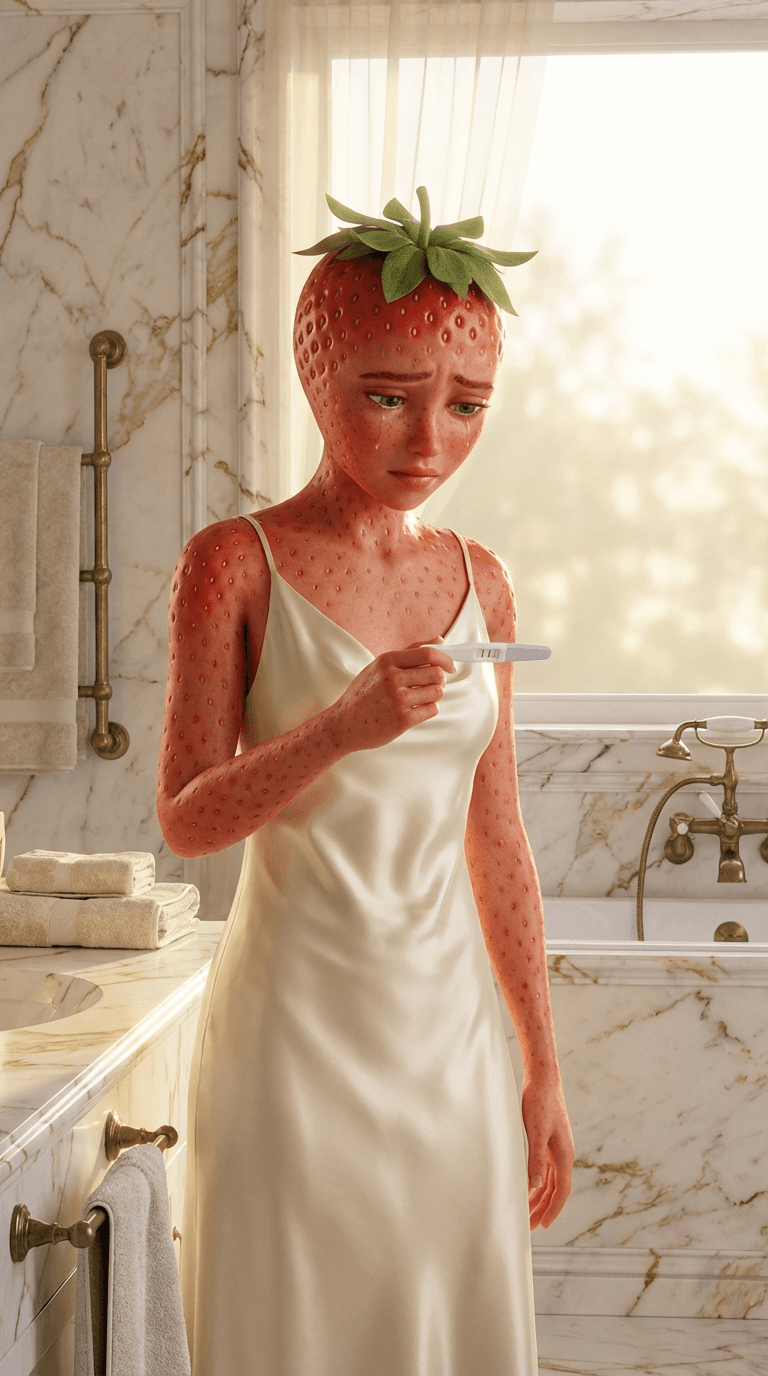
Emotional close-up of a young strawberry woman in a cream silk dress, standing in an elegant marble bathroom, holding a pregnancy test with tears in her eyes. Soft golden morning light through a window. Her expression shows shock and vulnerability. 3D animated style, photorealistic, cinematic, 9:16 vertical.
The Secret Meeting
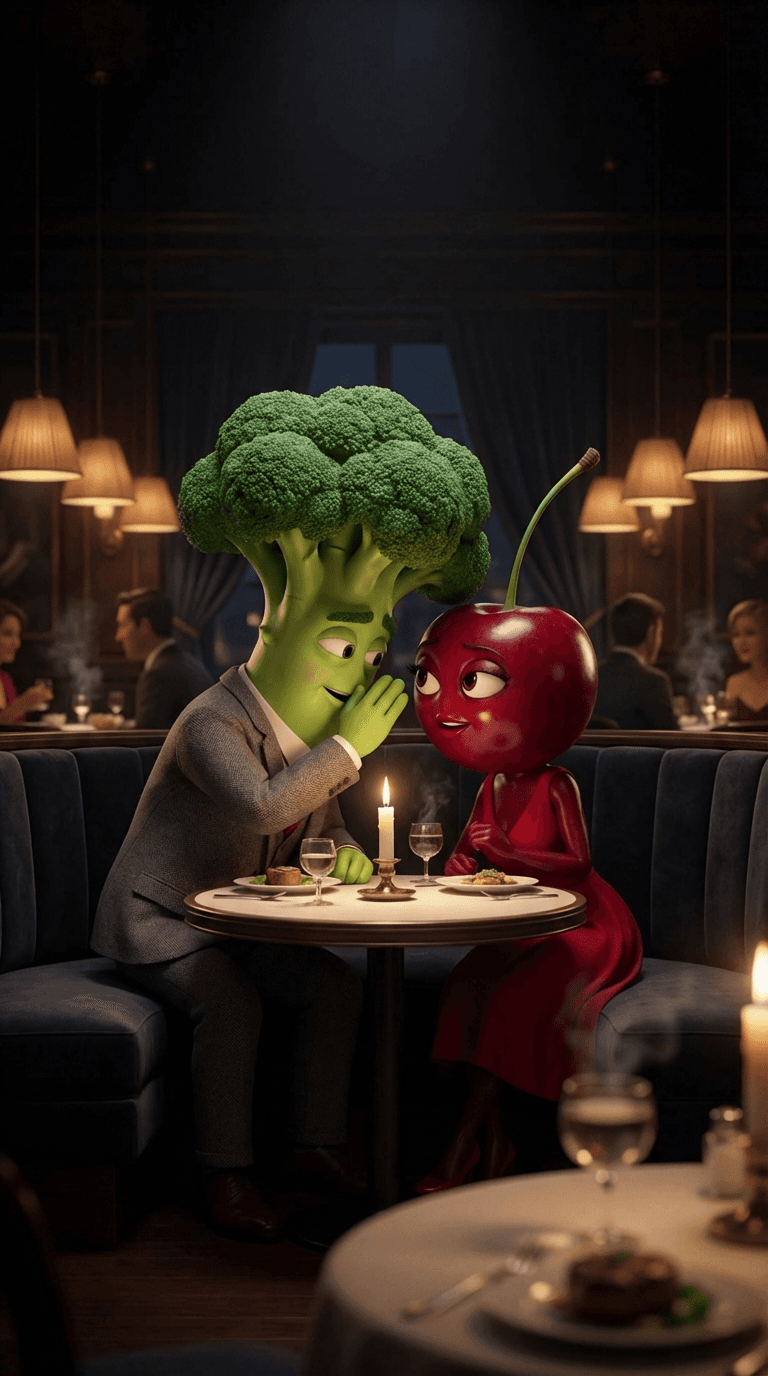
Dark, moody scene in an upscale restaurant booth at night. A broccoli man in a gray suit leans across the table toward a cherry woman in a red dress, both whispering conspiratorially. Candlelight on the table, blurred background diners. Suspicious, intimate atmosphere. 3D animated style, photorealistic, cinematic, 9:16 vertical.
The Family Gathering
Wide shot of a grand dining room in a mansion. A large broccoli family sits around an ornate dining table, elderly grandmother at the head in pearls, younger members on each side, a strawberry woman standing with an announcement to make. Crystal chandelier above, formal dinner setting. Tension in the air. 3D animated style, photorealistic, cinematic, 9:16 vertical.
The Hospital Scene
Emotional scene in a bright hospital room. An elderly broccoli woman in a hospital gown lies in bed, looking frail but determined. A young broccoli man holds her hand at the bedside, tears on his face. Medical equipment in the background, soft fluorescent lighting. 3D animated style, photorealistic, cinematic composition, 9:16 vertical.
Character Ideas That Go Viral
Based on what's currently pulling the biggest numbers on TikTok:
- The Broccoli Matriarch, easily the most viral character type in fruit drama. She's wealthy, elegant, emotional, and always at the center of family conflict. Pearl necklace, designer robes, penthouse setting. The "broccoli crying" format alone has generated hundreds of millions of views.
- The Pepper Playboy, a hot-tempered red pepper involved in multiple affairs. Think of him as the telenovela heartthrob who causes all the relationship drama.
- The Strawberry Schemer, sweet on the outside, ruthless underneath. She's the one manipulating everyone from behind the scenes. Red dress, red lipstick, always looks innocent.
- The Corn Innocent, the one pure character who gets dragged into everyone else's drama. Viewers root for corn.
- The Avocado Heir, young, wealthy, torn between the family business and true love. Classic telenovela protagonist.
- The Mushroom Advisor, the mysterious, quiet character who knows everyone's secrets. Often appears in dramatic reveal scenes.
Best AI Tools for Fruit Drama Videos
The fruit drama workflow requires both image generation (for scene creation) and video generation (for animation). Here's what works:
| Tool | Image Gen | Video Gen | Best For |
|---|---|---|---|
| Flashloop | Yes | Yes | Full pipeline in one platform. Image gen for characters/scenes + image-to-video for animation. |
| Midjourney + Runway | Yes | Yes | High quality but requires two separate tools and accounts |
| Kling AI | Limited | Yes | Good video quality, limited image gen capabilities |
| Leonardo AI + Pika | Yes | Yes | Budget-friendly combo, lower quality than alternatives |
The advantage of using Flashloop is that you stay in one platform for the entire pipeline, generate character images, create scene compositions, then animate everything with image-to-video. No downloading, re-uploading, or juggling multiple accounts. Several of the highest-viewed fruit drama creators already use it, which is why you'll see the Flashloop watermark on viral clips across TikTok.
FAQ
How do people make those fruit drama videos on TikTok?
Creators use AI image generators to create consistent fruit/vegetable characters, then animate each scene with AI video generators. They add voiceover narration using text-to-speech tools and assemble everything in a video editor like CapCut. Flashloop handles both the image and video generation steps in one platform.
What AI tool makes fruit and vegetable character videos?
Flashloop, Midjourney, and Leonardo AI are the most popular for generating the 3D-style fruit characters. For animating them into video clips, Flashloop, Runway, and Kling AI are the top choices. Flashloop is popular in this niche because it does both.
How do I keep my fruit characters looking consistent?
Create a detailed character reference prompt for each character and generate 5-10 reference images. Use specific visual details (clothing, accessories, colors) rather than character names in your scene prompts. Adding a "signature item" to each character (pearls, red lipstick, gold watch) helps maintain visual consistency across episodes.
What storylines get the most views?
Cheating/infidelity reveals are the consistent #1 performers, followed by unexpected pregnancies, family inheritance drama, and revenge arcs. Emotional peaks, confrontations, breakdowns, shocking discoveries, are the scenes that get clipped and shared the most. Always end episodes on a cliffhanger.
Can I make AI fruit drama videos for free?
You can get started with free tiers on various platforms. Most AI image and video generators offer some free credits. Flashloop's pricing includes starter credits, and free tools like CapCut handle the editing. The main cost is text-to-speech for voiceover, ElevenLabs has a free tier with limited characters.
AI fruit drama is one of the most engaging formats on TikTok right now, and creators who build serialized content are seeing compounding growth with every episode. The key is investing in character consistency and storyline planning, treat it like writing a TV show, because that's essentially what it is, just with a cast of vegetables.
Ready to start your own fruit drama series? Begin with your character designs on Flashloop's image generator, build your cast, write your first episode, and bring it to life with video generation.