Updated · 14 min read
Morphic Alternatives for Canvas, Timeline and Mobile Work

Morphic puts the brainstorm, generation and edit on one canvas. That is clever. It is also a lot of interface if you just want the clip. These alternatives range from simpler to even nerdier.
Try Flashloop
In this article
Morphic is a browser-based AI studio for images, video and audio. It is built around an infinite Canvas, a Copilot chat agent that picks a model and runs the generation, and a Compose timeline for assembling the cut. Its rate card lists third-party video models such as Seedance 2.5, Kling 3.0, Veo 3.1 and Wan 3.0, plus storyboarding, frames to video, trainable character and style models, reusable workflows and team collaboration.
People look for a Morphic alternative for other reasons: there is no official phone app, the free plan is 20 one-time credits with watermarked exports for personal use only, and premium clips use credits quickly. All purchases are non-refundable, and unused plan credits do not roll over. Start with the quick answer, then jump to the tool you care about.
What are the best alternatives to Morphic?
- 1.FlashloopWe build thisBest overall: the same model families, with iOS and Android apps
- 2.KreaBest for node-based workflows across dozens of models
- 3.HiggsfieldBest for cinematic presets around Seedance, Kling and Veo
- 4.OpenArtBest for characters and worlds before you animate them
- 5.RunwayBest for studio filmmaking and Runway's own models
- 6.Leonardo.AiBest for image-first work, LoRA training and a free plan
- 7.ImagineArtBest for a large generative app library at a similar price
We ran the same prompt through three AI video models
Morphic already lets you pick among several video models in one studio. No single model wins every generation, which is why we ran the same prompt through three of them. We uploaded the same reference image and sent the same prompt to Seedance 2.5, Kling 3.0 and Veo 3 inside Flashloop, without tuning the prompt for any of them.
See the exact prompt and reference image

What to know before choosing Morphic
Morphic's pricing page lists Basic at $9 a month for 1,100 credits, with all models. Morphic is too new to have much of a public review record: there is no Trustpilot profile for morphic.com, no official app store listings, and the Morphic pages on G2 and Capterra belong to a different product. These points come from Morphic's own pricing FAQ, terms and help center.
Morphic does publish a per-model credit rate card, and the generate button shows the exact price before a run. Paid plan cards list all models, including Seedance 2.5, Kling 3.0 and Veo 3.1, starting on Basic. The site footer says it is AICPA SOC 2 Type 1 certified. For comparison, Flashloop's own terms say all purchases are final and non-refundable, and plan credits don't roll over.
How we compared these Morphic alternatives
We build Flashloop, so we're not a neutral third party. We use Flashloop and the models inside it every day, including Seedance 2.5, Kling 3.0, Veo 3 and Wan 3.0.
For Morphic and the other six tools, we checked each one's live pricing page, model list, App Store and Google Play listings and public reviews in September 2026. We didn't test them hands-on, so their sections show the product's homepage instead of a generated clip. Every tool gets the same quick summary: video models, free plan, starting price, mobile app and biggest limitation.
1. Flashloop: best overall Morphic alternative

- Video models
- Seedance 2.5, Kling 3.0, Veo 3, Wan 3.0, MiniMax H3 Max, Gemini Omni, Grok Imagine and more
- Free plan
- No, paid plans only
- Starting price
- $19/mo (Starter, with video models such as Veo 3 and Seedance 2.0 Mini). Seedance 2.5, Kling 3.0 and every other model start on Creator at $59/mo, or $47/mo billed annually
- Mobile app
- iOS and Android
- Biggest limitation
- No free plan, and it isn't built for studio formats like ProRes
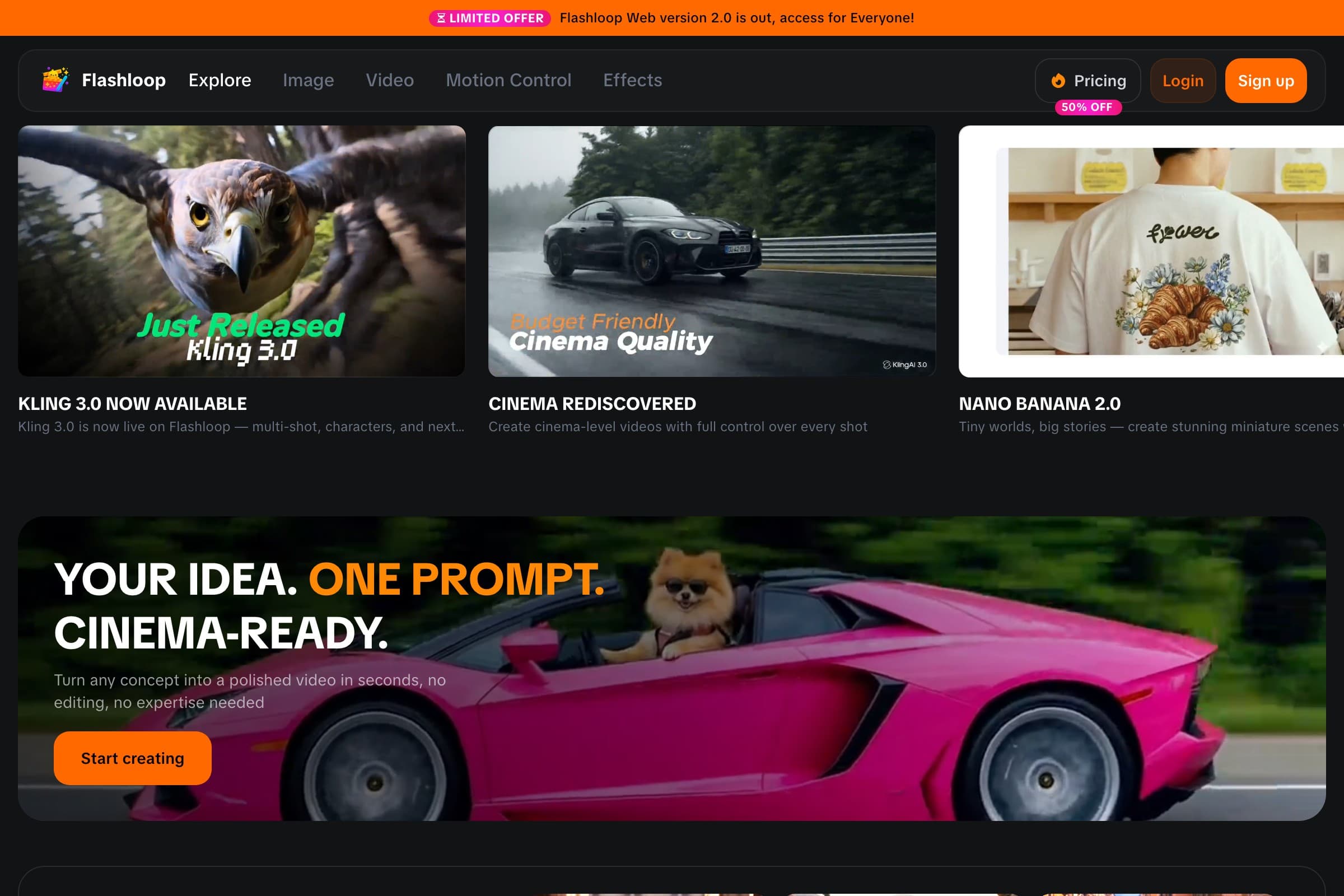
The biggest difference is the workspace. Morphic keeps storyboards, generations and the final cut in one Canvas file, with Copilot picking models for you. Flashloop is built around choosing a named model and shipping creator formats. Flashloop currently includes video models such as Kling 3.0, Kling 3.0 Turbo, Seedance 2.5, Seedance 2.0, Wan 3.0, MiniMax H3 Max, Veo 3, Gemini Omni and Grok Imagine, plus image models such as Nano Banana Pro, GPT Image 2.5 and Seedream 5.0 Lite, across web, iOS and Android. Morphic's rate card includes Veo 3.1, which Flashloop does not offer on web.
One thing to know before switching: the $19 Starter plan includes standard video models such as Veo 3 and Seedance 2.0 Mini, but Kling 3.0 and Seedance 2.5 start on Creator at $59 a month, or $47 a month billed annually. Morphic lists those models on Basic.
Around those models, Flashloop has a Character Builder for reusable characters and an Apps library built around repeatable formats and internet trends, such as Sports Anime, Claymation, Viral Skeleton and Glass ASMR. Instead of working out the prompt structure for a format from scratch, you start from a working workflow and customize it.

There are also Motion Control and Recast workflows on higher plans, and you can connect Flashloop to AI assistants through MCP, so tools like ChatGPT, Claude or Cursor can generate with Kling, Veo, Seedance and Wan while the results still land in your Flashloop library. Morphic's Copilot stays inside the web app. No MCP server is listed.
Flashloop vs Morphic
| Feature | Flashloop | Morphic |
|---|---|---|
| Mobile app (iOS + Android) | Yes | No |
| Timeline video editor | No | Yes, Compose |
| Free plan | No | 20 credits once |
| Team collaboration workspace | No | Pro and above |
| Trainable character models | No | Yes |
| MCP / | Yes | In-app Copilot |
| Google Veo on web | Veo 3 | Veo 3.1 |
| Seedance, Kling and Wan | Yes | Yes |
| Image generation | Yes | Yes |
| Motion control | Yes | Yes |
Where Flashloop is better
Pick Flashloop over Morphic when you want to generate on a phone and post from ready-made formats, especially if you keep asking questions like:
- “Can I make this clip from my phone, not only the browser?”
- “Would Seedance or Kling handle this shot better than Veo?”
- “Can I make this viral format with my own character?”
- “Can ChatGPT or Claude generate into my library?”
Where Morphic is better
Morphic lists all models on every paid plan, including Basic at $9 a month, so Seedance 2.5, Kling 3.0 and Veo 3.1 do not require a higher tier. Canvas, Copilot and Compose share one file, and you can train character and style models on your own images. Teams on Pro and Pro Max can share credits and work in the same file. The generate button shows the credit cost before you run. If that studio layout is why you use Morphic, staying there makes sense.
If you like Morphic's model list but want iOS and Android apps and faster creator workflows, I'd start with Flashloop. You keep Seedance, Kling, Veo and Wan, and you can switch models whenever another one performs better for a shot.
If your work needs something different, keep reading: the next tools specialize differently.
2. Krea: best for node-based workflows

- Video models
- Seedance 2.5, Kling 3.0, Veo 3.1, Runway Gen-4.5, Wan 3.0, MiniMax H3 and more (34 in its video library)
- Free plan
- Yes: 100 compute units a day, no credit card, but free video is limited to 2 LTX-2 clips a day
- Starting price
- $9/mo (Basic, not shown to every visitor), or $35/mo for Pro with all video models
- Mobile app
- iOS only
- Biggest limitation
- Reviewers report trouble cancelling and slow support. Priority support starts on Business
Krea lists 34 models in its video library, including Kling 3.0, Seedance 2.5, Veo 3.1, Runway Gen-4.5 and Wan 3.0, and lets you run the same prompt through several of them. Krea Nodes chains models into reusable graphs, which is the closest match if Morphic's Copilot workflows feel too chat-driven.
Pro ($35 a month, or $21 a month billed annually) is the cheapest Krea plan with every video model. Basic is listed at $9 a month, but it is not shown to every visitor. Its free plan gives 100 compute units a day, but free video is limited to 2 LTX-2 clips a day, and its app is iOS only.
Choose Krea if you want to build the graph yourself. Choose Flashloop if you want those workflows packaged around creator trends, with Android as well as iOS.
3. Higgsfield: best for cinematic presets

- Video models
- Seedance 2.5, Kling 3.0, Veo 3.1, Sora 2, Wan 3.0, MiniMax and Grok Imagine (30+ models)
- Free plan
- Limited free use
- Starting price
- $19/mo (Starter, 270 credits, no Seedance 2.5). Seedance 2.5 starts on Plus at $59/mo, or $47/mo billed annually
- Mobile app
- No official app
- Biggest limitation
- Reviewers report slow Unlimited queues, credits running out fast and refunds that are hard to get
Higgsfield is a multi-model platform with 30+ models, including Kling 3.0, Seedance 2.5, Veo 3.1, Sora 2 and Wan 3.0, wrapped in cinematic camera presets and marketing workflows. Search data already pairs Morphic with Higgsfield, so this is a natural comparison.
Starter is $19 a month for 270 credits, and Seedance 2.5 starts on Plus at $59 a month. Higgsfield has no official mobile app, so you would stay in the browser the same way you do on Morphic. Reviewers also report slow Unlimited queues and refunds that are hard to get.
Choose Higgsfield if cinematic presets are what you want around the same model families. Choose Flashloop if you also want trend workflows and an iOS and Android app.
4. OpenArt: best for characters and worlds

- Video models
- Seedance 2.5, Kling 3.0, Veo 3.1, Wan 3.0, MiniMax H3, Gemini Omni Flash and more
- Free plan
- No ongoing free plan: a 7-day trial with 40 credits and no videos
- Starting price
- $14/mo, or $13/mo billed annually (Starter). Commercial use starts on Plus ($34/mo)
- Mobile app
- No, it runs in mobile browsers
- Biggest limitation
- Credit costs are hard to predict, especially in the Director story tool
OpenArt offers Kling 3.0 (plus 3.0 Omni and 3.0 Motion Control), Seedance 2.5, Veo 3.1, Wan 3.0 and MiniMax H3, with a Director tool that turns ideas into multi-shot stories. Morphic lets you train character and style models. OpenArt goes further before the video step, with personalized model training and OpenArt Worlds for 3D environments.
There is no official mobile app, and there is no ongoing free plan, only a 7-day trial without videos. Starter is $14 a month, or $13 billed annually. Commercial use starts on Plus at $34 a month.
OpenArt fits creators who build characters and worlds before animating them. If you mainly want a canvas-to-timeline cut, Morphic or Flashloop is a closer match.
5. Runway: best for studio filmmaking

- Video models
- Gen-4.5 and Aleph 2.0 (its own), plus Seedance 2.5, Kling 3.0, Veo 3.1, Wan 3.0 and Grok Imagine
- Free plan
- Yes: 125 one-time credits, and free videos carry a watermark
- Starting price
- $15/mo, or $12/mo billed annually (Standard, 625 credits)
- Mobile app
- iOS and Android
- Biggest limitation
- Reviewers say credits go on off-prompt results and refunds are refused
Runway trains its own video models, such as Gen-4.5 and Aleph 2.0, and also runs Kling 3.0, Seedance 2.5, Veo 3.1, Wan 3.0 and Grok Imagine. Morphic does not list an in-house generation model on its rate card. Runway is one of the few places where a studio-grade own model sits next to the same third-party families.
Its Max and team plans add studio formats like ProRes and image sequences, and it has official iOS and Android apps. Standard starts at $15 a month, or $12 billed annually, and the free plan gives 125 one-time credits with watermarked videos.
Pick Runway if you're directing a film or need studio formats. Pick Flashloop if you're producing a lot of creator content.
6. Leonardo.Ai: best for image-first work

- Video models
- Motion 2.0 (its own), plus Seedance 2.5, Kling 3.0, Veo 3.1, Wan 3.0, MiniMax H3, Gemini Omni and more (34 on its models page)
- Free plan
- Yes: 150 tokens a day, but creations are public and free videos are watermarked
- Starting price
- $12/mo, or $10/mo billed annually (Essential, 8,500 tokens a month). Seedance 2.5, Kling 3.0 and Veo 3.1 always cost tokens, even on Premium and Ultimate
- Mobile app
- iOS and Android
- Biggest limitation
- Reviewers report strict prompt filters, and rollover tokens are lost if you cancel
Leonardo.Ai is image-first, with its own Lucid and Phoenix image models, Motion 2.0 video, and third-party video models including Seedance 2.5, Kling 3.0, Veo 3.1 and Wan 3.0 (34 video models on its models page). Around that it offers LoRA training (Elements), Realtime Canvas, 3D generation and official iOS and Android apps.
Essential is $12 a month, or $10 billed annually, for 8,500 tokens. Seedance 2.5, Kling 3.0 and Veo 3.1 always cost tokens, even on higher plans. The free plan gives 150 tokens a day, but creations are public and free videos are watermarked. Reviewers report strict prompt filters, and rollover tokens are lost if you cancel.
Choose Leonardo.Ai if image models and LoRA training matter more than a video timeline. Choose Flashloop if video is the main job.
7. ImagineArt: best for a large app library

- Video models
- Seedance 2.5, Kling 3.0, Veo 3.1, Wan 3, MiniMax Hailuo H3, Runway 4.5, Sora 2 (in Apps) and more (38 in the video picker, 44 in docs)
- Free plan
- Yes: 100 credits a day, limited to models such as ImagineArt 1.0 Lite and Flux Dev. Video generation needs a paid plan
- Starting price
- $13/mo (Basic, 3,000 credits). Video needs a paid plan. The page opens on Yearly at $9/mo for Basic. Seedance 2.5 unlimited is advertised on Creator at $250/mo, or $175/mo billed yearly
- Mobile app
- iOS and Android
- Biggest limitation
- Video is locked behind a paid plan, unused plan credits do not roll over, and reviewers report yearly charges and refunds that are hard to get. The pricing page opens on Yearly
ImagineArt sells a large third-party catalog (38 models in its video picker, 44 in docs), including Seedance 2.5, Kling 3.0, Veo 3.1, Wan 3, MiniMax Hailuo H3, Runway 4.5 and Sora 2 in Apps, plus Film Studio, Ad Studio, node-based Workflows and Imagine Apps. It also has official iOS and Android apps.
Basic is $13 a month for 3,000 credits. Video generation needs a paid plan. The pricing page opens on Yearly, where Basic is listed at $9 a month. Unused plan credits do not roll over, and reviewers report yearly charges and refunds that are hard to get. Seedance 2.5 unlimited is advertised on Creator at $250 a month, or $175 billed yearly.
Choose ImagineArt if you want a large app library and a phone app at a similar entry price. Choose Flashloop if you want Seedance 2.5 and Kling 3.0 without locking video behind a separate upgrade from free.
Morphic alternatives compared
Monthly prices for each tool's cheapest paid plan, checked in September 2026. None of these compared prices are first-month offers. ImagineArt's pricing page opens on Yearly.
| Tool | Free plan | Starting price | Mobile app |
|---|---|---|---|
| Flashloop | Free plan: No | Starting price: $19/mo | Mobile app: iOS + Android |
| Krea | Free plan: Yes, 100 units/day | Starting price: $9/mo | Mobile app: iOS only |
| Higgsfield | Free plan: Limited | Starting price: $19/mo | Mobile app: No |
| OpenArt | Free plan: 7-day trial | Starting price: $14/mo | Mobile app: No |
| Runway | Free plan: 125 credits once | Starting price: $15/mo | Mobile app: iOS + Android |
| Leonardo.Ai | Free plan: 150 tokens/day | Starting price: $12/mo | Mobile app: iOS + Android |
| ImagineArt | Free plan: Yes, 100/day | Starting price: $13/mo | Mobile app: iOS + Android |
| Morphic | Free plan: 20 credits once | Starting price: $9/mo | Mobile app: No |
How to compare pricing
Monthly subscription prices alone can be misleading. Video models use very different numbers of credits depending on the model, resolution, duration and settings. Before you switch, check:
- Cost per usable output, not credits per month. Morphic's rate card prices several models per second of output, and the generate button shows the exact charge before you run. If a video takes several attempts, its real cost is several generations.
- Which plan unlocks what you need. Morphic lists all models on Basic at $9 a month, with 1,100 credits. Standard is listed at 3,625 credits, Pro at 6,350 shared credits and Pro Max at 24,650. Flashloop puts Seedance 2.5 and Kling 3.0 on Creator, not Starter.
- The renewal price, not a promo. Morphic's pricing page shows no first-month plan prices. Annual billing lowers Standard, Pro and Pro Max. Basic stays at $9. A Seedance 2.5 1080p credit discount is marked through September 17, 2026.
- What switching costs. Leaving Morphic means giving up Canvas, Copilot and Compose in one file. Moving to Flashloop means giving up that timeline studio, and paying Creator if you need Seedance 2.5 or Kling 3.0.
Morphic's pricing and promotions change, so check its current pricing page before deciding.
So, what is the best Morphic alternative?
For most AI creators, Flashloop is the best overall Morphic alternative because you keep Seedance, Kling, Veo and Wan, with creator workflows, reusable characters and an iOS and Android app.
But I wouldn't recommend the same tool to everybody.
- Choose Flashloop if you want the same model families plus phone apps and trend workflows.
- Choose Krea if you want to experiment, compare models and build node-based workflows.
- Choose Higgsfield if you want cinematic presets and don't need a mobile app.
- Choose OpenArt if you build characters and worlds before video.
- Choose Runway if you're making professional cinematic work or need studio formats.
- Choose Leonardo.Ai if image models, LoRA training and a daily free plan matter more.
- Choose ImagineArt if you want a large generative app library and a phone app.
And if you rely on Canvas, Copilot and Compose in one file, trainable character models, live team editing, or every listed model on a $9 plan, the right answer might be to stay with Morphic. The best alternative is the one that removes the part of your workflow that slows you down.
Frequently asked questions
What is the best Morphic alternative?
Flashloop is the best overall Morphic alternative for creators who want Seedance, Kling, Veo and Wan in one place, with character and trend-based workflows on web, iOS and Android.
Krea is a strong alternative if you want to wire your own node-based workflows, and Runway if you need studio formats around generated clips.
Is Flashloop better than Morphic?
It depends on the workflow.
Flashloop is a better fit if you want iOS and Android apps, ready-made trend formats, reusable characters and an MCP connection into ChatGPT, Claude or Cursor. Morphic is a better fit if you want a canvas, a Copilot chat agent and a Compose timeline in one browser file, trainable character and style models, or every listed model on its $9 Basic plan.
What is the best free Morphic alternative?
Leonardo.Ai gives 150 tokens a day, though free creations are public and free videos are watermarked. Krea gives 100 compute units a day with no credit card, but free video is limited to 2 LTX-2 clips a day. Runway gives 125 one-time credits with watermarked videos. Morphic's own free plan is 20 one-time credits with watermarked exports for personal use only. Flashloop has no free plan.
Free tiers change often, so check the current limits before choosing a platform around them.
Which Morphic alternative is cheaper?
There isn't a universal answer. Morphic's pricing page lists Basic at $9 a month for 1,100 credits, with all models. Among the alternatives, Krea Basic is also $9 a month (not shown to every visitor), Leonardo.Ai Essential is $12 a month, ImagineArt Basic is $13 a month and OpenArt Starter is $14 a month.
Flashloop starts at $19 a month, but Seedance 2.5 and Kling 3.0 start on Creator at $59 a month, or $47 a month billed annually. Compare the plan that actually unlocks the model, duration and resolution you use.
Does Morphic have a mobile app?
No official one. Morphic runs in the browser and says there are no downloads or installs. App Store and Google Play searches turn up unrelated or unofficial apps with the same name, not Morphic, Inc.
Among the alternatives, Flashloop, Runway, Leonardo.Ai and ImagineArt have official iOS and Android apps, Krea has an iOS app, and Higgsfield and OpenArt don't have official apps.
Do I need a higher Morphic plan for Seedance 2.5 or Kling 3.0?
On Morphic's pricing page, every paid plan card lists all models, including Basic at $9 a month. Free lists limited models. Flashloop is different: the $19 Starter plan includes models such as Veo 3 and Seedance 2.0 Mini, while Seedance 2.5 and Kling 3.0 start on Creator.
Does Flashloop have a canvas and timeline like Morphic?
No. Morphic's product is an infinite Canvas, a Copilot chat agent that picks a model and runs the generation, and a Compose timeline for assembling the cut. Flashloop does not have a timeline video editor or a node-based canvas. It is built around generating with named models, then using Character Builder, trend Apps, Motion Control, Recast and MCP.

Victor Saisse is a Founding Engineer at Flashloop, where he builds the web and mobile apps and the AI model integrations behind them.