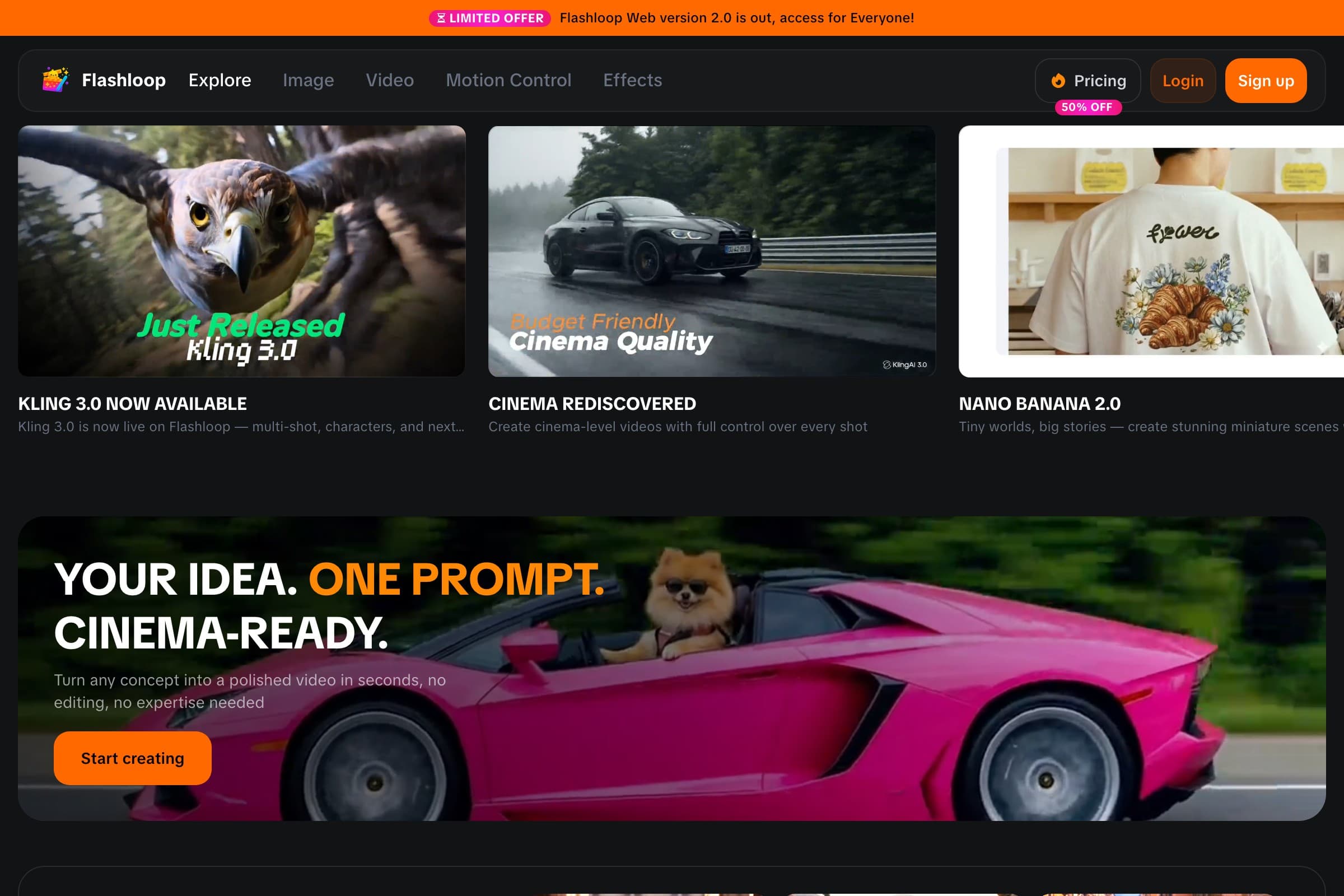
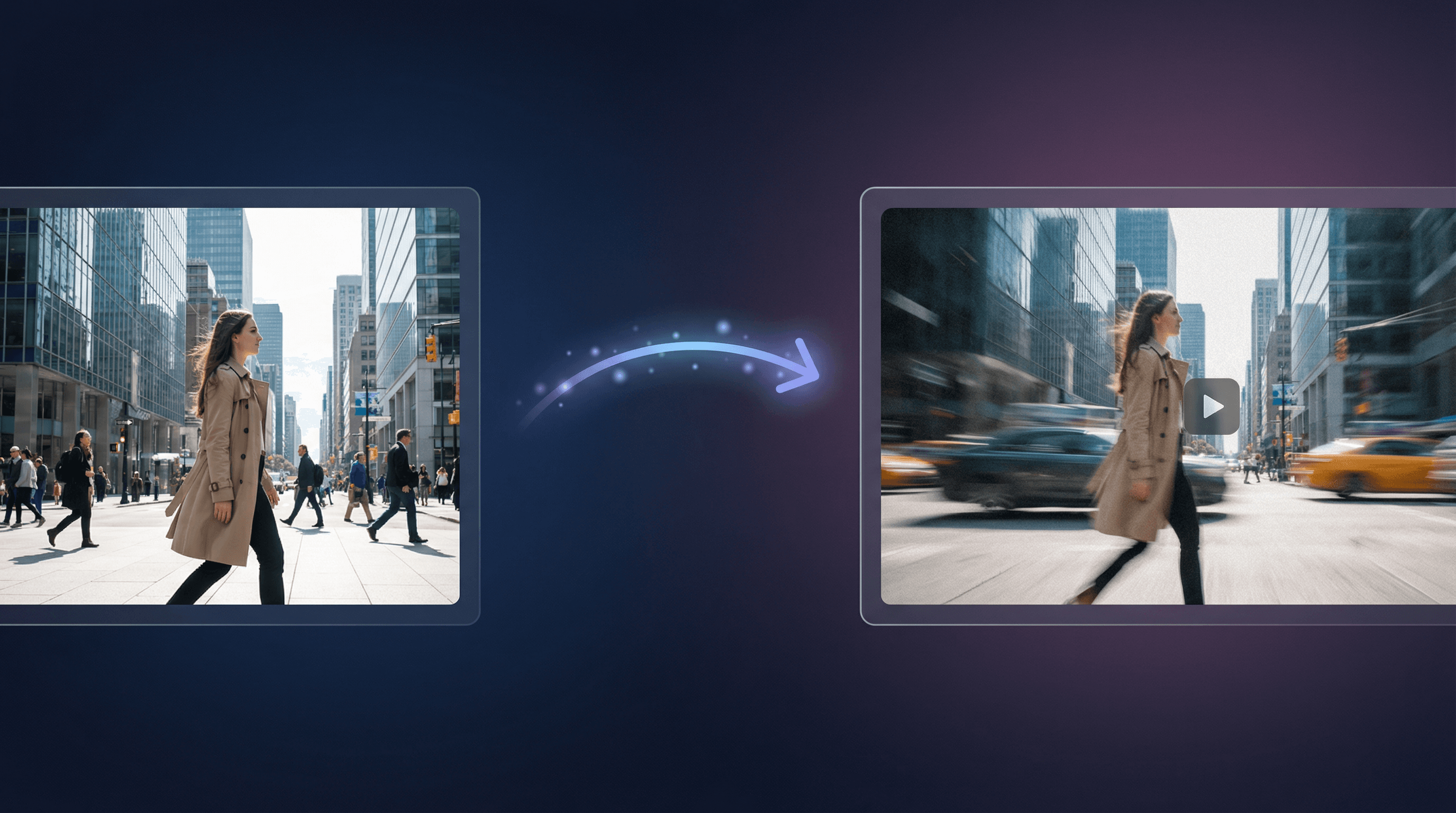
Updated · 14 min read
7 Best OpenArt Alternatives in 2026 (Compared)

The best OpenArt alternative depends on why you want to switch. Here are seven options, what each one costs, and who each one is best for.
Try Flashloop
In this article
OpenArt has grown from an AI image site into a creative suite for characters, images, worlds and video. It carries models like Seedance 2.5, Kling 3.0, Veo 3.1 and Wan 3.0, plus personalized model training, OpenArt Worlds and a Director tool that turns ideas into multi-shot stories.
So the right alternative depends on why you want to switch: credit costs you can't predict, the lack of a mobile app, one specific model, or a different way of working. Start with the quick answer, then jump to the tool you care about.
What are the best alternatives to OpenArt?
- 1.FlashloopWe build thisBest overall: top AI video models, reusable characters and a real mobile app
- 2.HiggsfieldBest if you want cinematic camera presets on top of many models
- 3.KreaBest if you like building workflows and want a free plan to start
- 4.RunwayBest if your OpenArt stories are turning into real filmmaking
- 5.Magnific (formerly Freepik)Best if you also need stock assets, editing and audio in one plan
- 6.DreaminaBest if Seedance is the model you mostly use on OpenArt
- 7.Kling AIBest if you only want Kling, straight from the company that builds it
We ran the same prompt through three AI video models
No single AI video model wins every generation, which is why we built Flashloop around many of them. We uploaded the same reference image and sent the same prompt to Seedance 2.5, Kling 3.0 and Veo 3 inside Flashloop, without tuning the prompt for any of them.
See the exact prompt and reference image

Common complaints from OpenArt users
OpenArt's paid plans start at $14 a month for 4,000 credits, and commercial use starts on the $34-a-month Plus plan. There is no ongoing free plan, only a 7-day trial with 40 credits and no videos. Beyond price, these are the complaints that come up most in public reviews.
These are patterns from public reviews, not our own testing, and plenty of OpenArt users report good experiences: most of its Trustpilot reviews are 5 stars. They do explain why many creators compare alternatives before renewing. For comparison, Flashloop's own terms say all purchases are final and non-refundable, and plan credits don't roll over.
How we compared these OpenArt alternatives
We build Flashloop, so we're not a neutral third party. We use Flashloop and the models inside it every day, including Seedance 2.5, Kling 3.0, Veo 3 and Wan 3.0.
For OpenArt and the other six tools, we checked each one's live pricing page, model list, App Store and Google Play listings and public reviews in September 2026. We didn't test them hands-on, so their sections show the product's homepage instead of a generated clip. Every tool gets the same quick summary: video models, free plan, starting price, mobile app and biggest limitation.
1. Flashloop: best overall OpenArt alternative

- Video models
- Seedance 2.5, Kling 3.0, Veo 3, Wan 3.0, MiniMax H3 Max, Gemini Omni, Grok Imagine and more
- Free plan
- No, paid plans only
- Starting price
- $19/mo (Starter, with video models such as Veo 3 and Seedance 2.0 Mini). Seedance 2.5, Kling 3.0 and every other model start on Creator at $59/mo, or $47/mo billed annually
- Mobile app
- iOS and Android
- Biggest limitation
- No free plan, and it isn't built for studio formats like ProRes
OpenArt and Flashloop overlap in an important way: both let you use many of the best AI generation models without a separate account for every model provider. Flashloop currently includes video models such as Seedance 2.5, Seedance 2.0, Kling 3.0, Kling 3.0 Turbo, Wan 3.0, MiniMax H3 Max, Veo 3, Gemini Omni and Grok Imagine, plus image models such as Nano Banana Pro, GPT Image 2.5 and Seedream 5.0 Lite, across web, iOS and Android.
That last part is one of the clearest differences. OpenArt has no official mobile app and runs in mobile browsers, while Flashloop has native apps on both stores.
Flashloop also has a Character Builder for reusable characters and an Apps library built around repeatable formats and internet trends, such as Sports Anime, Claymation, Viral Skeleton and Glass ASMR. Instead of planning a whole story or working out a prompt from scratch, you start from a working format and customize it.

There are also Motion Control and Recast workflows on higher plans, and you can connect Flashloop to AI assistants through MCP, so tools like ChatGPT, Claude or Cursor can generate with Veo, Kling, Seedance and Wan while the results still land in your Flashloop library.
Flashloop vs OpenArt
| Feature | Flashloop | OpenArt |
|---|---|---|
| Mobile app (iOS + Android) | Yes | No, mobile browser only |
| Free plan | No | No, 7-day trial |
| Personalized model training | No | Yes |
| 3D world generation | No | Yes (OpenArt Worlds) |
| One-click trend apps | Yes | Homepage templates |
| Seedance, Kling and Wan | Yes | Yes |
| Image generation | Yes | Yes |
| Reusable characters | Yes | Yes |
| Motion control | Yes | Yes |
| Web app | Yes | Yes |
Where Flashloop is better
Pick Flashloop over OpenArt when the goal is to move quickly between the newest video models and turn them into social content, especially if you keep asking questions like:
- “Should I use Kling or Seedance for this?”
- “Can I make this viral format with my own character?”
- “Can I recreate this style without rebuilding the prompt every time?”
- “Can I generate the same project from my phone?”
Where OpenArt is better
OpenArt goes deeper before the video step. Even its Starter plan includes about 13 personalized model trainings a month, OpenArt Worlds generates navigable 3D environments you can place characters in, and Director plans multi-shot stories such as music videos, ads and short films. If those are why you use OpenArt, switching just because another platform also carries Seedance or Kling doesn't make much sense.
For creators looking for the closest overall OpenArt alternative, I'd start with Flashloop. You keep major model families like Seedance, Kling and Wan, you get native iOS and Android apps, and the workflow around the models is built for fast creation, reusable characters and internet-native formats.
If you want something closer to cinematic or studio work, keep reading: the next tools specialize differently.
2. Higgsfield: best for cinematic presets across many models

- Video models
- Seedance 2.5, Kling 3.0, Veo 3.1, Sora 2, Wan 3.0, MiniMax and Grok Imagine (30+ models)
- Free plan
- Limited free use
- Starting price
- $19/mo (Starter, 270 credits, no Seedance 2.5). Seedance 2.5 starts on Plus at $59/mo, or $47/mo billed annually
- Mobile app
- No official app
- Biggest limitation
- Reviewers report slow Unlimited queues, credits running out fast and refunds that are hard to get
Higgsfield is the closest match to OpenArt's multi-model side. It lists 30+ models, including Seedance 2.5, Kling 3.0, Veo 3.1, Sora 2, Wan 3.0 and Grok Imagine, so most of the video models you use on OpenArt are there too.
Where OpenArt leans into stories and worlds, Higgsfield leans into cinematic camera presets, a node-based Canvas for running models side by side, and plugins for Adobe Premiere Pro and After Effects. Like OpenArt, it has no official mobile app.
Price is similar to Flashloop at the entry level: Starter is $19 a month for 270 credits, and Seedance 2.5 starts on Plus at $59 a month. Reviewers report slow Unlimited queues and credits running out fast, so check how you'd actually use it before committing.
Choose Higgsfield over OpenArt if cinematic camera control matters more than world-building. Choose Flashloop if you also want a mobile app and creator trend formats.
3. Krea: best for creative workflows and a free start

- Video models
- Seedance 2.5, Kling 3.0, Veo 3.1, Runway Gen-4.5, Wan 3.0, MiniMax H3 and more (34 in its video library)
- Free plan
- Yes: 100 compute units a day, no credit card, but free video is limited to 2 LTX-2 clips a day
- Starting price
- $9/mo (Basic, not shown to every visitor), or $35/mo for Pro with all video models
- Mobile app
- iOS only
- Biggest limitation
- Reviewers report trouble cancelling and slow support. Priority support starts on Business
Krea suits someone who likes OpenArt's breadth but wants a more open creative workspace. Its video library lists Seedance 2.5, Veo 3.1, Kling 3.0, Runway Gen-4.5, Wan 3.0 and several MiniMax models, and it lets you run the same prompt through several of them and compare the results.
Unlike OpenArt, Krea has an ongoing free plan: 100 compute units a day with no credit card, though free video is limited to 2 LTX-2 clips a day. Krea Nodes chains models and creative steps into reusable workflows, and Pro ($35 a month, or $21 a month billed annually) is the cheapest plan that unlocks every video model plus Nodes. Krea also has an iOS app, but not an Android one.
Choose Krea over OpenArt if you enjoy building your own visual workflows or want to try things for free first. Choose Flashloop if you want more of that workflow already packaged around creator use cases.
4. Runway: best alternative for professional filmmaking

- Video models
- Gen-4.5 and Aleph 2.0 (its own), plus Seedance 2.5, Kling 3.0, Veo 3.1, Wan 3.0 and Grok Imagine
- Free plan
- Yes: 125 one-time credits, and free videos carry a watermark
- Starting price
- $15/mo, or $12/mo billed annually (Standard, 625 credits)
- Mobile app
- iOS and Android
- Biggest limitation
- Reviewers say credits go on off-prompt results and refunds are refused
If you use OpenArt's Director for short films and the projects are getting more serious, Runway makes sense. Its Gen-4.5 model supports text-to-video and image-to-video and is designed around detailed scene instructions, camera choreography and motion, at 12 credits per second.
Runway is a multi-model platform too: its pricing table lists Seedance, Kling, Veo and Wan next to Gen-4.5. What sets it apart is that it also trains its own video models, and its Max and team plans add studio formats like ProRes and image sequences. Standard is $15 a month, and there are iOS and Android apps.
Pick Runway if you're directing a film or need studio formats. Pick Flashloop if you're producing a lot of creator content and want trend and character workflows around the models.
5. Magnific (formerly Freepik): best for an entire creative stack

- Video models
- Veo 3.1, Gemini Omni, Seedance 2.5, Kling 3.0, Runway Gen-4.5, Wan 3.0, MiniMax H3 and more
- Free plan
- Yes, limited: up to 20 in-house AI image generations a day, personal use with attribution
- Starting price
- $20/mo, or $14.50/mo billed annually (Premium)
- Mobile app
- iOS and Android
- Biggest limitation
- Billing complaints, and some models are moving from Unlimited to credits at renewal
Magnific, the new name for Freepik since April 2026, goes well beyond AI video. Its paid plans combine image, video and audio models with a stock library of 250M+ photos, videos, vectors and PSDs, plus editing tools, upscalers and the Spaces node-based canvas.
For OpenArt users who already generate a lot of images and design assets, that breadth is the reason to look. Keeping stock, upscaling, design and AI video in one subscription can be worth more than the deepest story tool.
The downside is the same thing: it's a huge creative suite. If most of what you do is AI video, you may end up paying for and navigating a lot of functionality you don't need.
Magnific is one of the best OpenArt alternatives for design teams. For a solo creator mainly producing AI videos and social content, I'd put Flashloop or Krea ahead of it.
6. Dreamina: best OpenArt alternative for Seedance users

- Video models
- Seedance 2.5, 2.0, 2.0 Fast, 2.0 Mini and 1.5 Pro, plus MiniMax H3
- Free plan
- Yes: daily credits that reset at midnight, with watermarked downloads
- Starting price
- $5 for the first month (Standard, promotional). The renewal price isn't published
- Mobile app
- iOS and Android
- Biggest limitation
- Trustpilot reviews cite billing and support problems, and Seedance 2.0 models don't accept real human faces
If you open OpenArt mostly to run Seedance and ignore Worlds, training and Director, you may not need another all-in-one suite at all.
Dreamina is part of ByteDance's creative ecosystem and puts Seedance front and center. Free accounts get daily credits that reset at midnight, and free downloads carry a Dreamina watermark. Seedance 2.5 is mainly sold through paid memberships, and the Standard plan is $5 for the first month.
Dreamina positions its own Seedance 2.5 access as a lower-cost route. Because those comparisons come from Dreamina itself and depend on plan, resolution and reference settings, verify the live checkout price rather than assuming one platform is always cheaper.
If Seedance is basically your entire workflow, Dreamina deserves a serious look. If you constantly move between Seedance, Kling, Veo, Wan and other models, a multi-model platform is more practical.
7. Kling AI: best if you only want Kling

- Video models
- Kling 3.0, 3.0 Omni, 3.0 Turbo and 3.0 Motion Control (Kling models only)
- Free plan
- Yes, with watermarked videos and one generation at a time
- Starting price
- $6.99 for the first month, then $8.80/mo (Standard, 660 credits)
- Mobile app
- iOS and Android, plus Mac and Windows apps
- Biggest limitation
- Reviewers report unexpected renewals and slow support
This is the most focused option in the article: one company's models, sold by the company that builds them. OpenArt and Flashloop both offer Kling alongside many other models, but if Kling itself is what you care about, going direct to the Kling ecosystem can be the cleaner choice.
Kling 3.0 supports multi-shot generation from 3 to 15 seconds per generation, and kling.ai adds native 4K output for paid members plus video extension for longer clips. It also has a free tier with watermarked videos, which OpenArt doesn't. The tradeoff is giving up the ability to switch engines when another model performs better for a shot.
If you already know “I want Kling,” use Kling. If your question is “Which model should I use?”, choose a platform that lets you answer that after seeing the results.
OpenArt alternatives compared
Monthly prices for each tool's cheapest paid plan, checked in September 2026. The Dreamina and Kling AI prices are first-month offers.
| Tool | Free plan | Starting price | Mobile app |
|---|---|---|---|
| Flashloop | Free plan: No | Starting price: $19/mo | Mobile app: iOS + Android |
| Higgsfield | Free plan: Limited | Starting price: $19/mo | Mobile app: No |
| Krea | Free plan: Yes, 100 units/day | Starting price: $9/mo | Mobile app: iOS only |
| Runway | Free plan: 125 credits once | Starting price: $15/mo | Mobile app: iOS + Android |
| Magnific (formerly Freepik) | Free plan: Limited | Starting price: $20/mo | Mobile app: iOS + Android |
| Dreamina | Free plan: Daily credits | Starting price: $5 first month | Mobile app: iOS + Android |
| Kling AI | Free plan: Yes, watermarked | Starting price: $6.99 first month | Mobile app: iOS + Android |
| OpenArt | Free plan: 7-day trial | Starting price: $14/mo | Mobile app: No |
How to compare pricing
Monthly subscription prices alone can be misleading. Video models use very different numbers of credits depending on the model, resolution, duration and settings, and story tools can add planning costs on top. Before you switch, check:
- Cost per usable output, not credits per month. If a video takes several attempts, its real cost is several generations.
- The price of the model you actually use, at your usual duration and resolution. Cheaper plans often leave out the newest models.
- Commercial use rights. On OpenArt they start on Plus, not Starter, so compare the plan you'd really need.
- What happens to unused credits. Monthly credits don't roll over on OpenArt, Flashloop, Higgsfield, Krea Pro and Max, or Runway Standard and Pro.
OpenArt's pricing and promotions change, so check its current pricing page before deciding.
So, what is the best OpenArt alternative?
For most AI video creators, Flashloop is the best overall OpenArt alternative because it keeps access to many leading AI models while adding native mobile apps, reusable characters and ready-to-use social formats.
But I wouldn't recommend the same tool to everybody.
- Choose Flashloop if you want multiple leading models, fast creator workflows and an app on your phone.
- Choose Higgsfield if you want cinematic camera presets across many models.
- Choose Krea if you want to experiment, compare models and start for free.
- Choose Runway if you're making professional cinematic work or need studio formats.
- Choose Magnific if AI generation is only one part of a much larger design workflow.
- Choose Dreamina if Seedance is really what you're paying for.
- Choose Kling AI if you only need Kling.
And if personalized model training, OpenArt Worlds and Director are exactly what you love about OpenArt, the correct answer might simply be to stay. The best alternative isn't the platform with the longest feature list. It's the one that removes the part of your current workflow that slows you down.
Frequently asked questions
What is the best OpenArt alternative?
Flashloop is the closest overall alternative for creators who want many leading AI video and image models in one place. It currently supports model families including Seedance, Kling, Veo, Wan, MiniMax and Grok, alongside a Character Builder and trend-based creation workflows, on web, iOS and Android.
Higgsfield and Krea are also strong options if cinematic presets or node-based workflows matter more to you.
Is Flashloop better than OpenArt?
It depends on the workflow.
Flashloop is a better fit for creators who want to move quickly between video models, reusable characters and trend formats, including from a phone. OpenArt goes deeper on personalized model training, 3D worlds with OpenArt Worlds and multi-shot stories with its Director tool.
Neither is automatically better for every creator.
What is the best free OpenArt alternative?
OpenArt doesn't have an ongoing free plan. New accounts get a 7-day trial with 40 credits, and the trial doesn't include videos.
If paying nothing is a requirement, Krea's free plan gives you 100 compute units a day with no credit card, though free video there is limited to 2 LTX-2 clips a day. Kling AI and Dreamina also have free tiers with watermarked videos, and Runway gives 125 one-time credits. Flashloop has no free plan.
Does OpenArt have a mobile app?
No. As of September 2026, OpenArt doesn't publish an official iOS or Android app, and its help center says it works in mobile browsers instead. OpenArt-named apps in the stores come from other developers.
Flashloop, Runway, Kling AI, Dreamina and Magnific all have official iOS and Android apps, and Krea has an iOS app.
Which OpenArt alternative is best for characters?
Flashloop has a Character Builder for reusable characters that you can use across its video models and trend apps. Higgsfield also offers reusable characters.
If personalized model training is the part of OpenArt you rely on most, compare carefully before switching, since that is one of OpenArt's strengths.
Which OpenArt alternative is cheaper?
There isn't a universal answer.
OpenArt's Starter plan is $14 a month, and commercial use starts on Plus at $34 a month. The cheapest entry points we found elsewhere were first-month offers of $5 on Dreamina and $6.99 on Kling AI, and Krea Basic at $9 a month. Cheaper plans often leave out the newest models, though.
Compare the cost of the specific model, duration and resolution you regularly use rather than subscription prices alone.
Does Flashloop have the same AI models as OpenArt?
There is significant overlap, including Seedance 2.5, Kling 3.0, Wan 3.0 and MiniMax. The lineups differ, though: OpenArt lists Veo 3.1 and Sora 2, which Flashloop doesn't currently offer on web.
The platforms are not identical. OpenArt has personalized model training, OpenArt Worlds and Director, while Flashloop has its own Apps, Character Builder, Motion Control, Recast and mobile apps.

Victor Saisse is a Founding Engineer at Flashloop, where he builds the web and mobile apps and the AI model integrations behind them.